Labels

Showing posts with label Dogo Argentino. Show all posts

Thursday, 10 September 2015

Understanding Different Dog Tolerance Levels

A Normal Trait that is as Flexible as it is Manageable.  This information is designed to help demystify the common trait of dog-dog aggression.  Dog aggression shows up in numerous breeds, and it's generally "no big deal" ...unless you deny it, misunderstand it or exploit it.  Like so many dog owners, we expect that our dogs have the potential to show some degree of dog aggression in select situations.  Our job as responsible stewards is to keep our pets out of those situations by reading their body signals and understanding their individual limits.  At the same time, we work to improve the tolerance of each dog through appropriate socializing opportunities.  Because dog aggression is not a "one size fits all" trait, outlined below are four very common levels of dog-tolerance that we've come to recognize in our work with the dogs.

1.  Dog Social - A dog that truly enjoys the company of other dogs, including house matedogs.  Very easy going; forgives even the rudest dog manners.  Dog-social dogs include most puppies and a percentage of socially mature (14 months and older) Pit Bulls.  Some call these dogs 'cold' Pit Bulls.

2.  Dog Tolerant - Typically non-reactive on leash and either indifferent or friendly to other dogs.  Is well socialized and shows relaxed, easy body language in the presence of new dogs.  May not 'love' dogs that he doesn't know, but has decent tolerance for rude behavior; a long fuse.  Enjoys known dog friends and, in general, succeeds with housemate dogs.

3.  Dog Selective - Has dog friends but is more selective.  May dislike certain 'types' of dogs and/or is easily offended by rude dog manners. Likes to dictate the rules during dog-play.  Can succeed with housemate dogs with supervision.

4.  Dog Aggressive - Has a very limited number of dog friends; sometimes, no dog friends.  May be opportunistically leash reactive with a weak handler and/or no training.  May have a short fuse during play, even with dogs that it knows.  Needs heavy supervision during play and a good leader when out on leash.  Many live successfully with housemate dogs (usually opposite sex) with proper supervision and safe management protocol.

The Bell Curve of Dog Aggression:  Dog tolerance levels are flexible and are determined by environmental factors (handler influence, training and socializing efforts) as much as they are determined by genetics.  Dog social dogs can become less social as they come into their maturity, and dog aggressive dogs can become much more tolerant with good direction and proper socialization.  With the combined
factors of maturity, socialization, good leadership and training, most Pit Bulls fall comfortably in the middle spectrum of this bell curve.


Wednesday, 9 September 2015

Can you trust a dog?

“I don’t like one of your ownership rules,” writes an offended website visitor. “‘Never leave a dog alone with a child’?? My dog is totally trustworthy around my kids!”

Trust can be difficult to define. But, in essence, if you trust a dog, you have a feeling of certainty that the dog will not fail your expectations.

What do you expect from your dog? Dogs liv
e in the moment. They do not have morals. Dogs react to instinctual drives; they do not think about how their actions will affect them or others. Only through a great deal of training and effort can we give our dogs a very rudimentary understanding of cause-and-effect. Dogs cannot think at the level that people do.

Some owners expect their dogs to think logically, to have morals, and to behave like people. Such expectations are unrealistic. You can trust that a dog will think and act like a dog. You can also trust that a dog will not behave like a person.

You can expect (or trust) a dog to:

Jump up on people
Bark
Bite
Chase moving objects
Fight
Lick
Whine
Scratch and paw
Run around
If you own a dog, he will not let you down if you expect these behaviors.

You cannot expect (or trust) a dog to:

Distinguish “good guys” from “bad guys”
Suppress predatory instinct when faced with shrill noises and small, fast-moving objects
Lie down and accept a painful or frightening situation
Stay in the yard when the gate is wide open
Do something just because you said so
Be a “good dog” without any guidance or training
Understand human morals, virtues, and expectations

Some people trust dogs to act and think the way people do. These people are offended by responsible ownership rules because the rules do not trust dogs to behave like people. Some people think that when an owner follows the rules of responsible ownership, it is because that owner does not trust his or her dog to behave—that the dog is “bad.”

Responsible dog ownership rules are based on trust—a different definition of trust! The rules trust that dogs will behave like dogs, and the rules help dog owners to maintain that trust. Don’t be offended by responsible dog ownership rules, and don’t be ashamed to follow them! In order to be a responsible dog owner, you can and should trust your dog—to be a dog.

Dog Fighting - Finding The Truth

Dog fighting is a passion for some people and some think it a cruel act . Both sides have their own points to prove their opinion right , but the main point is who is right ?
       This article is not to explain what is dog fighting but this article is to know what you think about it . Main objective of this article is to know your views . The breed which is represented as face of dog fight is Pit Bull . Our objective is to know whether this breed really this much aggressive .
     I  hope everyone who will read this article will post his/her views . Share it maximum to know the views of world about dog fighting .

Dog Fighting Today

                      Dog fighting, despite its felony status in all 50 states, is still a grave concern to animal advocates. All across the country, humans abuse dogs in heinous ways. From nonchalant, impromptu ‘street fights’ to the large-scale organized matches held on a regular schedule at set locations, dog fighting still occurs every day.

                       Dog fighting is an ANIMAL ABUSE ISSUE. Pit Bulls happen to be the breed most used in dog fights. But if Pit Bulls did not exist, dog fighting would still take place. There is no quenching the blood lust of human ‘kind’. Brutality against animals in the form of staged matches or fights between animals or even between man and animal is an activity almost as old as man himself – it was in existence long before the Pit Bull. Those who make dog fighting a PIT BULL ISSUE do the dogs a grave disservice. These dogs are VICTIMS in every sense of the word. Exploited, abused, tortured for human gain, Pit Bulls are innocent beings caught up in a tragic societal issue.

                       
                  Pit Bulls are NOT part of the problem. The only PROBLEM is PEOPLE. The dogs are not perpetrators, they are not evil partners of the humans, nor are they mere ‘tools’ of a ‘trade’. These dogs abused by man are living, feeling, breathing, helpless victims, with a world to offer if humans would only give them the chance. They have so much worth and substance, but their countless positive traits are trampled on and stifled by the real ‘animals’ who mistreat them. Allowed the opportunity to blossom into their true selves, even those dogs who have been exposed to the cruelty of the pit can live as companions and enjoy those luxuries afforded to ‘normal pet dogs’. Dogs saved from fighting busts do not need ‘rehabilitation’ – what they need is a chance to show who they truly are, their intrinsic natures - their positive attributes of love, trust, loyalty, courage, and gentleness.

Why Do Pit Bulls Fight?

                     Coming soon.........

Tuesday, 8 September 2015

Dog Fighting History

Dog Fighting
History

                    Fights between two or
A dogfight, c. 1785
more animals have always been popular spectacles. The Romans, the Greeks, Spanish, as well as French have pitted dogs  against other animals, dating back hundreds or thousands of years. So when the British people began selectively breeding the popular old-time bulldog for use in dog-on-dog combat, they couldn't take credit for having been the first to pit one animal against another. (It seems the bloodlust of humans extends across time and the globe!)

                   The dogs that were used in these British dog fights became known as the American Pit Bull Terrier.

                    The original, old-time bulldog was used for all manner of stock-related work, particularly as a catch dog: used by the butcher to manage unruly bulls,  and by the hunter for help in catching and holding wild boar and other  game. The sport of bull baiting became popular in England, having arisen from  these functional jobs that the bulldog performed for humans.  

                     Baiting was extremely popular and nearly a national past time. At one point, there was even a law mandating that the flesh of a bull could only be sold if the animal had  been baited prior to slaughter. But the baiting of animals was  eventually outlawed due to the increasingly loud voices of opposition.

                   And so humans--with their insatiable lust for blood and violence-- turned to the sport of dog-on-dog fighting.

A turn-up between a dog and Jacco Macacco,
 the fighting monkey, 1822
                   The bulldog, mixed with tough hunting terriers, was created to be used in this emerging ‘sport’. Selectively bred down to a smaller size to increase agility in the pit, these dogs were also bred for stamina and wrestling ability. However, the most important trait in the fighting dog was gameness. Gameness--the willingness to keep going and not give up--is a trait common to breeds of bulldog ancestry. It may also be described as that plucky, never-say-die attitude seen in terriers. Lastly, the fighting dog had to be easily handled by humans, and so any aggression shown towards people was carefully selected against.
                     These dogs were eventually to become known as the “Pit Bulldog” or “Pit Bull Terrier”, the precursors to our modern  APBT.

                    Pit Bulldogs (the new bulldog/terrier fighting dogs)were imported to America around the time of the Civil War, and they gained great popularity over the years. The dogs were not only the fighting dog of choice, but they were also surprisingly popular with the general public who embraced the breed wholeheartedly.

                   Viewing art and old photographs from the early to mid 1900’s, you can see that the Pit Bulldog was viewed as a valuable part of American culture.  Back then, the breed was known as a sound family companion, and a dog that was great with kids—despite the fact that it was also a fighting breed.

                   In the realm of the American dogman, dog fights provided betting opportunities, entertainment, and also served as a means to establish and then preserve a specific type of dog--the American Pit Bull Terrier (aka “Pit Bull”). In 1898 the United Kennel Club was formed in order to preserve the breed, establish a stud book, and create rules for the pit. UKC founder CZ Bennet officially named the breed: American Pit Bull Terrier. Through dog fights, breeders could identify certain traits in a dog and  then breed that dog that manifested the sought-after traits. Besides gameness, a  very stable, sound dog was extremely important. Aggression towards humans was not tolerated. Through this type of careful selection, the Pit Bull breed was refined. (Please see Pit Bull History for more information about the development of the breed.)

                  Dog fighting continued on into the 1900s, although it began to lose favor after the turn of the century. Throughout the 1900’s, dog fighting would gradually lose ground. The fighting amendment added to the Animal Welfare Act in 1976 helped propel stricter laws (and to push dog fighting underground where it unfortunately still flourishes). It was eventually outlawed as a felony all across America.


Dog Fighting Today -
                                Coming soon...


Simple steps for avoiding infections from dogs and cats

“Ugh! I’ve been kissed by a dog! I have dog germs! Get hot water! Get some disinfectant! Get some iodine!”—Lucy, after being licked by Snoopy in A Charlie Brown Christmas
Dog-kissing-girlAmericans share their households with an estimated 140 million dogs and cats. For the truly pet-centric among us, these creatures are family members, plain and simple. In addition to delivering that most elusive unconditional love, pet ownership confers several health benefits—including lower blood pressure and cholesterol levels—and increased opportunities for exercise and socialization.
Lucy may have overreacted after being smooched by Snoopy, but dogs and cats can transmit disease to people, either directly through licks, bites, and scratches; indirectly by carrying other infection-laden critters like fleas and ticks into the human environment, or by shedding tiny infectious organisms into our environment through feces. As a group, these diseases are called zoonoses (ZOH-uh-NOE-sees).
Most of the diseases we pick up from dogs and cats arise from bacteria, single-celled and wormlike parasites, and one virus (rabies). People with compromised immune systems (such as those with AIDS or those taking drugs to ward off rejection after receiving an organ transplant) and kids are at the highest risk of becoming sick with such ailments
The list of diseases transmissible from dogs and cats to people is quite long, but the risk of getting sick from such conditions is low—especially if you take a few simple precautions.

Beware bites, scratches, and smooches

While it is more likely that you’ll receive germs causing human disease while shaking hands than when getting smooched by a dog, saliva from a cat or dog—delivered via an affectionate lick, an accidental or aggressive bite, or a defensive scratch—may contain organisms that can cause illness if they penetrate the skin or come in contact with the mucous membranes of the mouth, nose, or eyes. The dog or cat that unknowingly transmits these germs usually shows no signs of illness. But once inside a human, these bacteria can cause skin infections, flu-like symptoms such as fever and chills, and more serious diseases such as meningitis.
The rabies virus is the most dangerous saliva-borne germ a cat or dog can bestow on a person. Thankfully, rabies in people is very rare in the U.S. (only 47 cases were reported between 1990 and 2005), and most of those cases are attributed to bites from wild animals such as bats and raccoons. One reason dogs and cats so rarely transmit rabies is our nation’s highly effective pet-vaccination programs.
A fastidious cat that cleans its paws with its abrasive tongue can transfer bacteria belonging to the bartonella family from its mouth to its claws. In such a case, a bite or a scratch can cause cat-scratch disease, which usually causes localized lymph node swelling near the injury site but can progressively affect the liver, eyes, or central nervous system.
Here are a few ways to avoid saliva-borne infections:
  • Socialize your pets with people so they are less likely to bite and scratch.
  • Thoroughly wash any bite or scratch wound with soap and water. Watch the area for swelling and redness. Puncture wounds should be seen by a doctor.
  • Make sure your pets are vaccinated against rabies. This is a legal requirement in most states.

Poop patrol

No one in their right mind intentionally touches or ingests dog or cat poop, but people can nevertheless expose themselves to several nasty disease-causing agents from it via contaminated soil or water. These include salmonella, a bacteria that humans more commonly get from contaminated food, and giardia, a single-celled parasite that can cause severe diarrhea.
Also, the eggs of intestinal worms—including roundworms, hookworms, and tapeworms—are commonly shed in animal feces, and people who accidentally ingest them can get become ill. Only the tapeworm can develop into an adult parasite in the human intestine, but the other worms in immature form can migrate to the skin, eyes, and other organs.
As if that weren’t enough, cat feces can carry a microscopic parasite (Toxoplasma gondii) that causes enlarged lymph nodes. Infected people usually don’t show symptoms, unless they have a weak immune system. Most important, women infected with toxoplasma during pregnancy can transmit the parasite to their developing fetus.
Here are a few precautions to take:
  • Make sure your pet gets an annual veterinary physical
  • If your pet develops diarrhea, treat it promptly.
  • Wash your hands thoroughly after cleaning up dog or cat feces and after gardening or exposure to soil that may harbor canine or feline fecal matter.
  • If you’re pregnant, have someone else clean out Felix’s litter box.

Freeloading fleas and ticks

The fleas and ticks that get a free ride and feed on domestic dogs and cats can also feed on humans, though they prefer hairier mammals. During feeding, those insects can transmit the germs that cause Lyme disease, ehrlichiosis (characterized by fever and headache), the malaria-like infection known as babesiosis, and even plague, most human cases of which occur in the Southwest U.S.
Follow these tips to stay insect free:
  • Use a veterinary-recommended flea- and tick-prevention product on your pet.
  • Check your pets for fleas and ticks regularly, even if they are on a preventive.
  • If your home is flea-infested, treat the indoor environment as well as the pet.
  • If you find a tick on your pet or yourself, remove it promptly and wash your hands afterward.
The bottom line with pets, people, and disease is this: Practice good hand washing and other common-sense personal hygiene measures, and give your pets good veterinary care. That will further reduce the already low risk of getting an unwanted ailment courtesy of your “best friend.”

Saturday, 29 August 2015

Tips & Warnings for Train a Guard dog

If you want to further develop your own understanding of training a dog's protection drives, seek out a responsible group such as a local schutzhund club that emphasizes creating a well-rounded working dog. These dogs are tested for sound temperament and must learn to perform at a high level in tracking and obedience as well as protection work. Find a reputable club that is a member of a national or international schutzhund organization. Before joining, spend some time learning about their organization, talking to members, and watching training sessions to determine whether you have the commitment needed to seriously engage in this demanding dog sport.

The most important aspect of guard dog training is control, which asserts your role as leader and normally comes from time you spend with your dog in enjoyable activities, including obedience training. A dog who is out of control and tries to be dominant can cause serious injuries and is far more of a liability than an asset. Never try to train your dog to bite or attack people. Doing so may be illegal in some states, and you place yourself at risk because you will be liable for injuries that result from an attack.

Monday, 3 August 2015

How to Break Up a Dog Fight

              The topic of how to break up a dog fight seems to evoke a wade-right-in, rather macho attitude in some people. But you don’t need to break up every dog fight, and there isn’t a single safe and perfect method of doing so. This week, how to tell when a fight is serious, and some ways to try to break it up, ideally without getting hurt yourself. - 

Should You Break Up a Dog Fight?

Dog fights call for a disclaimer--oh, boy, do they. It’s inherently dangerous to intervene in a dog fight, or even a canine argument. Yet the reality is that if your own dog is involved in a serious fight or an attack, you’re going to feel a strong urge to protect him or to stop him from doing grave damage to another animal. So though the ideas I offer don’t exactly constitute advice, you may as well know what various people have suggested and tried. But always remember that you may get hurt.
Also, this article doesn’t cover aggression between housemate dogs. If your own dogs are fighting regularly or making frequent ugly faces at each other, get skilled, in-person help.

Let Loud Dog Arguments Take Care of Themselves


I mentioned canine arguments above. Your ordinary dog-park squabble, in which the dogs move like lightning, roaring and snarling at the tops of their lungs, is a cue to stand back, get out of the way, and unbunch your undies. People say “The dogs would have killed each other if we hadn’t broken them up.” Actually, the dogs are talking trash. Almost always, if you leave them to their own devices, they either won’t hurt each other or will leave a couple of small punctures around the face, ears, and neck. The argument might last a minute from start to finish, though the time usually seems a lot longer to the people watching. Once the dogs are done, they’ll shake out their bodies and offer each other social reconciliation behaviors or just go about their business, paying each other no more mind.

Humans Can Make Loud Dog Arguments Worse

Often, though, several humans crowd in, shouting and screaming and grabbing at the dogs. These panicked, well-meant interventions not only amp up the dogs but put the people at risk of being bitten themselves. The dogs may be startled when a “third party”--a hand--appears behind or above them. Also, humans move so much more slowly than dogs. We get in the way of flashing teeth that otherwise would have been doing just that--flashing. Finally, if one dog has grabbed an ear or a fold of skin, being pulled away may cause him to clamp down and hold on. The result can be a bad tear when otherwise there wouldn’t have been any injury at all, or only a minor one.

Serious Dog Fights Are Often Quiet

In a real fight, you probably won’t hear the roaring and snarling that mark doggy trash talk. Both dogs may be dead silent. During a serious dog attack, the aggressor may be quiet while the victim dog screams. Some dogs may dart in and out, slashing at each other’s legs and bellies; others latch on and grind down. The victim may break free and try to escape, only to have the attacker go after him again. There’s no risk-free intervention we can make. I had a client with two Golden Retrievers, one of whom broke the other’s leg in an attack. The client tried to end the fight and the attacking dog then tore up her arm.

You Probably Won’t See Many Serious Dog Fights

Bearing the risk in mind, here are some of the suggestions I’ve heard. By the way, let’s forget about practice making perfect; unless you’re a dog fighter, or maybe you run a daycare
 that doesn’t pre-screen the dogs, you’re not likely to see enough serious fights in your lifetime to develop much expertise. Most important is to keep your cool--a tall order, but panic makes you think less clearly.

How to Most Safely Break Up Dog Fights

[[AdMiddle]You’ll notice that several of the tips depend on your happening to have some device or object conveniently to hand. Because we all go around with air horns in our pockets, don’t we? Yes, setting off an air horn is one idea. And it’s a good one, if you have an air horn.
If a hose is available, spray cold water on the fighting dogs. Indoors, try a bucket of water. More portable than a hose is a canister of citronella spray, but you have to have it with you and most people don’t think it will stop a serious fight. Dropping a blanket over the dogs to startle and quiet them is safe and easy, if of course you have a blanket; whether a blanket will stop a serious fight is another question. Some people recommend shoving a board or a sheet of plywood between the dogs, which sounds implausibly difficult to me--and again, unless the fight’s conveniently located in your home workshop or a lumber yard, good luck finding a suitable piece of wood. Another tool-based recommendation I’ve heard is to hit a latched-on dog in the face with a hose or a heavy stick. This obviously has potential for grave injury to the dog, so don’t resort to it lightly--remember, those flashy, noisy arguments that scare the hell out of people are almost always resolved quickly by the dogs themselves. They don’t need us to quote-unquote help.

Potentially Effective but Dangerous Ways to Break Up a Dog Fight

The interventions that I think likeliest to stop a serious fight or attack are, unfortunately, also the most dangerous to you. One is to grab the fighting dogs’ tails and pull the dogs up like wheelbarrows until they’re clear of each other. That works better with at least one person per dog; the big risk is, of course, that either or both dogs will whip around and go after the person holding their tail. With short-tailed or dock-tailed dogs, you could grab a leg instead, but that brings your face and upper torso closer to the action.

Breaking Up a Serious Dog Attack Can Get You Hurt

I’ve been fortunate enough to witness only one attack in which I thought the aggressing dog was going for a kill. The attacking dog’s tenacity is burned into my mind. While the victim dog screamed, a friend and I picked up the attacker by her tail and hind legs, but even dangling in the air she hung on to the other dog. We kicked her and punched her to no effect. I finally ended the attack by grabbing the attacker’s collar and twisting it to cut off her air. When she couldn’t breathe, she let go. Can I recommend this as a tactic? Really, no; I was lucky not to get hurt worse than I did.
Remember, most of the time most dogs will come out of most dog arguments mostly unscathed, and if you keep out of it, you’ll be unscathed too. Take a deep breath and let everybody’s heart rate come down.

Sunday, 2 August 2015

Top 15 Tips for Being a Responsible Dog Owner

Tips for Dog Owners 


1.  Obedience train your dog so he/she's a star in all situations.

2.  Neuter/Spay your dog to curb territorial aggression, to prevent more (and more and more) unwanted puppies, and prevent your dog from roaming.  All dogs are MUCH nicer to be around when they've been fixed!

3.  Encourage your dog to be a Social Butterfly. Socialize him/her with as many different people as possible such as kids, seniors, disabled folks, and people of all  ethnic groups.

4.  Socialize your dog with other dogs at a level that is GOOD for your dog. 

5.  Become a dedicated student of 'dog body language' and get to know your dog like the back of your hand in order to be able to anticipate and prevent potential dog-dog conflicts.  Learn about behaviors that indicate a dog is raising the stakes during a play session and be ready to intervene and watch for other triggers that could excite your dog into conflict.  Pay careful attention to the behavioral changes that develop as your dog moves through the changes in it's life, particularly any anticipated 'shift' from a social dog to a dog that has less tolerance.  This is common and normal in the terrier breeds, so keep your eye out. 

6.  Respect the leash laws!  Leash laws are a dog owner's best friend.  They help you navigate situations where another dog may provoke your dog into a fight. Know your rights as a dog owner.

7.  Understand that any sign of aggression towards a human is a major red flag and should be dealt with immediately with the help of a BREED EXPERIENCED trainer or behaviorist.  Dogs that show an inability to improve should be safeguarded from the public (in secure housings for example) or in some cases, humanely euthanized.  Pit Bulls were bred to be exceedingly friendly with people. 

8.  Exercise your dogs regularly so she/he can burn off that famous bulldog energy.  Pit bulls are intelligent athletes. Young dogs need at least two hours of your time each day.  A well exercised Pit Bull is a happy Pit Bull as well as it's owner!

9.  Understand that many people have had negative experiences with dogs and are sincerely afraid of them.  Give them reassurance when you can, rather than allow them to be unnecessarily frightened.  Pit Bull owners have to go above and beyond the call of duty sometimes to help some people get over their fear and prejudice. What Pit Bull lovers see as ADORABLE - others may see as scary.

10.  Try to develop a thick skin to help you endure rude or hurtful comments about your pet. 
11.  When out with your dog, pay attention to your surroundings and balance the needs of the public with your dog's needs.  This means picking up dog mess, not letting your dog jump on or annoy others, and avoid off-leash dogs that may run up and instigate a fight.

12.  If worse comes to worse and you have to break up a dogfight, stay calm, take a deep breath and be prepared to do it quickly and safely.  Pit Bull owners should know exactly how to do this with as little fuss as possible. You may want to carry a parting stick with you in areas where you might encounter loose running dogs that may harass or attack your leashed dog. 

13.  Research your dog's breed, including the history and original purpose of terriers so you can understand Pit Bull behavior.  It's no secret that Pit Bulls can show dog intolerance when challenged. Becoming familiar with canine behavior will prove to be a big help so that you can enjoy a great success with your pet.  Spread the word to other Pit Bull owners and be a responsible example for others.

14.  License and microchip your Pit Bull so that if she/he gets lost, your beloved friend can be returned to you.

15.  Despite all the work, enjoy your dog!  Whether your buddy loves a long hike, a fast swim or just a rip snoring power nap, you and your special friend deserve to keep soaking' up all the good bully love!

Tuesday, 28 July 2015

How to increase grip or jaw power in American Pit Bull Terrier or all other Game Breed Dogs

For a game breed dogs jaw power is most important things. A last longing grip is a dream that every owner of dog watch . In this article I am trying to give some tips to increase jaw power... You can also visit an article on this same topic at Increasing Grip Or Jaw Power

5 ways to increase Grip or Jaw Power

1. Spring Pole -

Spring Pole for APBT
  • To increase jaw power and grip spring pole is used as most prefered choice. With the help of spring pole a whole body exercise also get completed. So if you want to increase jaw power of dog spring pole is a good choice.


2. Food -

  • Food has vital role to increase jaw power. Calcium and mult
    Food for Pit Bull
    ivitamins are required to increase jaw strength and make teeth stronger.


3. Artificial Bone Chewing -

  • If you have real bones available than they are the best choice but if don't than artificial bone made from calcium and protein are good way to practice your dogs jaw. Dogs enjoy chewing them and also get stronger teeth and jaws.


4. Tug of War -

Tug of War Pit Bull
  • Many dog owners who have more than one dog can use this. Dogs get enjoyment in tug of war and also increases their jaw power. They have to hold the tug with strong grip to win this game and they enjoy a lot.


5. Old Tyres -

Increase grip with Tyres Pitbull
  • This exercise is similar to spring pole. But in this old bike or car tyre is used to increase the jaw power of dog.


How to build muscle in Pit Bull dog

5 Simple steps to build muscle in American Pit Bull Terrier


gamebreed.blogspot.com

1. Wait pulling - 
   

gamebreed.blogspot.com
  • Wait pulling is most trusted exercise to build muscle in dogs. A systematic use of this excercise help to build muscle.
2. Running -
gamebreed.blogspot.com

  • Running means only running not long walks. Running works on almost every muscle of your dog specially legs. It gives great results. 
3. Swimming -
gamebreed.blogspot.com

  • Swimming is also use-full to build muscle in your dog. Chest and legs get great benefit from it. Regular use of it provide great results.
4. Playing -

gamebreed.blogspot.com
  • Playing is also a good exercise. In this muscle get develop with intense involvement of dog in playing with other dogs. While playing jumps ,running etc help dog to build muscles.
5. Supplements -
  • Many Supplements are available in market those help to build only muscle mass. Max bully, orijen food products etc with protein help to build muscle mass. 


gamebreed.blogspot.com

You can also visit Conditioning Plan for more details

Monday, 27 July 2015

The “Game” Bred American Pit Bull Terrier Muscle Building Tips

The best ways to bulk up your Pit Bull

 Pit Bull Muscle Building Tips –  
     Having a Pit Bull or a Dog means that you need to understand that the structure of the animal requires that it has continuous muscle stimulation in order to stay in shape. A pit bull that lives without physical activity is going to become fat and slow, which is going to have serious effects on the health and vitality of the animal.
            In this article we are going to give you some pit bull exercises that you can use to train your dog and keep it strong and healthy.


The treadmill

            If you want to be able to warm up your dog in order for the muscles to get warmed up for the heavy workouts, you can always take your dog for a walk, but the treadmill is an even better solution. The reason for this is that you will provide your dog with plenty of exercise and you can increase the intensity in order to train the dog to walk faster and eventually run in the treadmill. So if you have one at home and you have patience, you can teach your dog to use it without any problems.

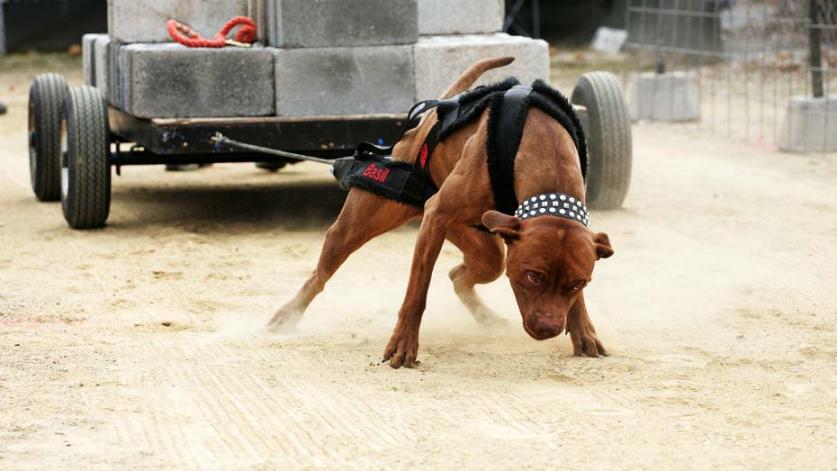
Drag weight with harness

            You can purchase a harness for your pit bull and attach tires or weights to it with a rope. Then you can get your dog to run as fast as possible while dragging the weight. This is an excellent exercise for explosiveness, but most importantly you will see that your dogs muscles will have more definition. Make sure that you learn to identify when your dog is getting too tired to continue. These animals tend to work until their exhaustion makes them faint, but this is not healthy either. Make sure that you stop this drill when your dog is to agitated and the breathing is too shallow.

The spring pole

          This is the ultimate exercise machine for the jaws and the neck of the pit bull. You will see a lot of amazing results when you use the spring pole and your pit bull will instinctively know how to use the spring pole to get a great workout. You can build a strong spring pole for you dog with a relatively small investment. You should install the spring pole at a height that your dog can barely reach because this is going to make the animal jump as hard as possible and that is also an important part of the workout.
            You should make sure that your dog is also going to have proper nutrition in order to build bigger muscles. If your dog gets a lot of exercise, but the nutrition is barely enough to maintain the current weight and muscle density, you are never going to see any gains. You have to provide enough nutritional value for the muscles on your dog to grow. Usually this means that you need to use some kind of supplement in order to get the right amount of proteins in order to build stronger muscles.

Allow your dog to rest every other day

The training needs to be one day of high intensity and another of walking slow treadmill warm ups. The reason for this is that the dogs muscles need to rest in order to grow. The muscle growth is not going to happen if there is constant stress and no resting periods are allowed. Always allow your dog to get plenty of sleep and rest. Also avoid exposing your dog to stressful situations that might cause their performance when exercising to be half as strong.

Muscld Building Ways is also a great article that you can also check.


World's Toughest Fighting Breed

What is the World's toughest fighting dog?

Many people seem to think that the two biggest competitors are the Japanese Tosa Inu and APBT better known as the American PitBull Terrier. The fighting dog of Japan is a large and aggressive dog which is surpsingly agile. They lack the stamina the APBT has. The Tosa is known as the sumo wrestler of the dog because dog fighting in Japan is similar to sumo wrestling. They have very similar rules. The Tosa can only fight for 30 minutes while the PitBull can last many hours. The Tosa has been faught under no time limit rules in America against the APBT and had different results. In Japan the Tosa is the lead dog. No dog can match him. But in America it's a whole different story. America's rules has no time limit while the Japanese rules have a 30 minute time limit. We will tell you the results at the end of this post.

Many dogs have been imported and faught against the Japanese Tosa Inu and the APBT and had very little to no success at all. These dogs include: Fighting Dog of Argentina, Perro de Presa Canario, American Bulldog and even two versions of Pakistani dogs, the Gull Terr(Bully Kutta) and the Gull Dong.

There are many recorded fights between Tosa Inu's and other dogs. An owner of a Neapolitan Mastino thought his dog was good enough to beat a Tosa owned by a man in Japan. He was apparently wrong as this fight turned out to be a 1 sided slaughter in favour of the Tosa. The fight was haulted to a stop so that no further harm comes to the Mastino.

There was another incident where an American Bulldog faught a Tosa Inu and was punished to the point that the Bulldog resorted to jumping out of the cage to get away from the Tosa.

The Fila is another big and strong dog. There were 2 incidents of a Fila taking on the Tosa and the Tosa won on both occasions with relative ease.

A young female Tosa Inu once faught to a draw with a male PitBull who was almost her size. 2 other incidents between a Male Tosa and a Male PitBull lead to the victory of the Tosa. One PitBull lost an eye and the other PitBull was severly injured.

In America, the Tosa and PitBull both had mixed results so it was a 50/50 thing. But in Japan it was a 9/10 for the Tosa.

Our experts have come to a conclusion that the World's toughest fighting breed is the Tosa.

We want to hear your opinion on this, so please comment. Thank You.

You can also check a great article on this same topic by visiting this linkToughest Fighting Dogs

How To Train a Dog For Fight


   As we point out repeatedly on previous and subsequent pages of this article: Dogfighting is a cruel practice, and it is a felony in every state of the United States and in many other nations around the world. But this is not just because of the actual fights. The process of raising and training fighting dogs is also cruel and harmful to animals. The specific breeds used in dogfighting are usually American pit bull terriers, Staffordshire bull terriers, American Staffordshire terriers and bulldogs. Due to frequent interbreeding, these dogs are often referred to simply as pit bulls. The animals used in dog fights have specifically been bred over generations to enhance aggressiveness. In fact, an official statement from The Humane Society of the United States said that breeders take advantage of pit bulls’ inherent loyalty to make them more aggressive with outsiders and other dogs [Source: The Humane Society of the United States ].

          Sometimes larger dogs, like Presa Canarios, are used or are crossbred with other fighting dogs. Taking a dog from birth to fully trained for fighting can take two years. The animals are often acquired from a pound, shelter or adoption agency. Top breeders sell puppies from a successful bloodline for more than $1,000 each. Floyd Boudreaux, considered the biggest figure in dogfighting for several years, sold his dogs for up to $10,000 [Source: The Humane Society of the United States].

        These dogs are not allowed to live normal lives. Instead, they spend their time chained in place, training or fighting. They often live in small cages and in filthy conditions. Handlers use extraordinarily heavy chains to hold dogs in place, frequently adding weights to them, all with the purpose of increasing a dog’s upper-body strength. Dogs are kept close to each other, but just out of reach in order to increase their antagonism.

       Professional dogfighters carefully structure training regimens. Food and nutritional intake are meticulously measured. Some trainers give dogs steroid injections and supplements. To build endurance, dogs are forced to run on treadmills and to swim in pools, sometimes for hours. Trainers keep detailed records of their dogs’ exercise and feedings.

       To enhance aggressiveness, the animals are frequently beaten and antagonized. They may also be starved. As part of training, handlers will take cats or rabbits, often stolen, and use these animals as “bait.” These bait animals are tied up while the dog is restrained, or they’re put in a small enclosure with the dog. After training with the bait, the handler unchains the dog and allows him to kill it. Handlers make their dogs tug on hanging objects, like tires, to increase jaw strength. Some handlers file their dogs’ teeth to be as sharp as possible so that maximum damage can be inflicted.

       A “roll,” a dog’s first fight, takes place when the dog is around 15 months of age. This test run between two dogs lasts about 10 minutes and allows handlers to measure each animal's demeanor. A dog that’s deemed a non-prospect may be neglected, abandoned or killed.


Sunday, 26 July 2015

Worlds most dangerous Game Breed dogs

10. Cane Corso

This large breed of Italian mastiff is a descendent of the dogs Roman soldiers used in wars. It has a sleek muscular body weighing up to 50kg (110lbs). The business end of the Cane Corso is its large, intimidating head with powerful jaws. One look would tell most people that this is a dog that could inflict a good deal of damage. The Cane Corso generally has a good temperament but is protective and suspicious of strangers. Therefore training and early socialisation are essential.
     You can also check an article on same topic by visiting Top Fighting Breeds
                    "This dog is restricted in several US states and European countries".

9. Wolf-Hybrids

I imagine the name itself here is enough to start alarm bells ringing! Often referred to as wolfdogs these dogs are at least half wolf and as such may be virtually indistinguishable from a pure wolf.
Behaviour varies according to the dog / wolf content. Wolf-like traits make the animal less likely to attack protectively but they retain a strong prey drive making them a real risk around other small pets, and potentially young children.
The cross-breeding also has implications on how aggressive the hybrid will be. Crossing with a dog with a protective nature, e.g. a German Shepherd can breed out the wolf’s shy retiring nature, making a less predictable more dangerous dog.
Weighing in at up to 55Kg (120lbs), with power and intelligence of a wolf – in the wrong setting these dogs have the potential to be dangerous.

8. Neapolitan Mastiff

On size alone this massive mutt has the ability to intimidate. Reaching up to 90kg (200lbs) that more than an adult human. It was a Neapolitan Mastiff that played the part of “Fang”, Hagrid , the half-giant’s dog in the Harry Potter films. The large mastiff-type head is complemented with an equally large body in which the musculature is barely hidden by thickly folded skin.

The Neapolitan Mastiff is thought to be the direct descendant of the ancient Roman Molossus used for both war and the bloodthirsty arena. In essence this dog was bred to be a capable killer making it a popular guard dog and defender. That said, these are generally calm and loyal dogs but correct training and socialization is essential. As is a firm owner – these dogs have and can kill.

7. Fila Brasileiro

Also known as the Brazilian Mastiff this is another very large powerful dog. Weighing up to 75kg (170lbs) the Fila Brasileiro was bred as a hunting dog trained to restrain but not kill its prey. During the days of slavery the Fila was allegedly used to return fugitive slaves, unharmed, to their masters. More recently it has become a popular guard dog.
What separates the Fila from other big mastiff type dogs is its temperament and potential for aggression. The dog is banned the UK, Norway, Israel and Denmark to mention a few along with being restricted in many more. It is often said that the Fila Brasileiro can be highly aggressive towards strangers if not correctly trained. Given the name Ojeriza, this behaviour may be desired by some owners but can make this a particularly dangerous breed.

6. Dogo Argentino

Although a little smaller than the mastiffs and the Dogo Argentino makes up for it in power. This agile and muscular dog was bred as a big game hunter’s companion able to bring down wild boar and pumas. The Dogo originated from the Cordoba Fighting Dog which was crossed with Great Dane amongst other breeds. The resulting dog is 60kg (130lbs) of lean muscle recognisable with its short white coat.
It is said that the aggressive traits have been largely bred out of the Dogo Argentino and it can even be a good family dog. However, the potential is there for this dog to attack with lethal consequences and as a result it is banned in many countries including the UK and Australia. The fact that it is a breed preferred by dog fighters further cements its reputation as a dog to be feared.

5. Rottweiler

The Rottweiler is a medium to large sized dog with a stocky powerful body. It used to be known as the butcher’s dog but that was due to it working with livestock and pulling the carts to market rather than anything more sinister. I remember a few years back when this was definitely the scariest dog around. Alongside some of the more exotic, bigger breeds the Rottweiler seems to have lost some of its edge. The fact remains though, that Rottweilers are capable killers and the statistics reflect this. As a more common breed the numbers are bound to reflect badly on the Rottweiler, and they do. In the US it has consistently been the second most frequent dog to attack causing death or serious injury.

4. Caucasian Shepherd

This enormous dog goes by several names including the Caucasian Shepherd Dog. It was bred to defend sheep flocks on the edges of the Soviet Union from thieves and, well, anything! A big dog can weigh anything up to 90kg (200lbs) with huge paws and equally intimidating set of jaws. Their thick fur hides a powerful muscular frame. Virtually fearless and able to exhibit ferocious behavior these dogs have long been a favourite for hunting bears. This is also the breed of dog used to patrol the border between East and West Germany during the Cold War.
Accompanying this size and power is a strong will and a loyalty which will see the dog attack practically anything when it feels its owner is under threat. Still favoured amongst dog fighters in Russia this dog is banned in some countries and restricted in others.

3. Tosa Inu

This huge Japanese dog was bred as a fighting dog. It varies in size but the biggest Tosas weigh in at a massive 100kg (220lbs) justifying the nickname of the “Sumo mastiff”. Over the years the breed has been crossed with mastiffs, Great Danes, Bulldogs, St Bernards and Bull Terriers. It tends to be significantly smaller in Japan but has been bred for size in the West.
The danger posed from this dog comes from its size, strength and fighting credentials. Usually a very calm breed, good training and an experienced owner is essential for the Tosa. Without this the potential for this dog to do damage is unlimited and fatal attacks have occurred. For this reason the Tosa Inu is banned in a whole list of countries.

2. Presa Canario

The Perro de Presa Canario or Canary Dog is one of the most intimidating looking dogs you will find. Its enormous, square head is almost as wide as it is long. It has the body to match too; big boned and muscular the Presa Canario can weigh around 60kg (130lbs). Bred as a fighting dog they retain a good degree of this aggression making them only suitable for experienced dog owners. If not shown absolute authority the Presa Canario can be an extremely dangerous dog. It is also said they gain aggression in numbers as they are pack dogs. This is certainly borne out by a number of fatal attacks most notably that of a San Francisco woman who was torn apart by a pair of these dogs owned by her neighbour.
The Presa Canario is banned in many countries.

1. Pit Bull

Barely a week goes by without a story of an horrific attack involving a Pit Bull does not feature in the news somewhere. Is the Pit Bull actually the most dangerous dog in the world, possibly not. However, in the face of overwhelming statistical evidence it it difficult to argue that this dog is not the most likely to attack you. Studies have consistently showed that Pit Bulls have been responsible for nearly a half of all recorded attacks including many fatalities.
It is worth pointing out that Pit Bull is an umbrella name referring to any number of dogs with particular physical characteristics. Even the experts can disagree as to what constitutes a Pit Bull but in general the dog is very stocky, muscular with a squarish head and powerful jaws. Despite being the smallest dog on the list, weighing less than 40kg (95lbs) the Pit Bull makes up in power, agility and ferocity. These dogs were bred for the pit (fighting) and more recently to look intimidating.
Of course much of the dogs reputation is the result of irresponsible owners. The worse the reputation the worse the owner and so it goes on. Perhaps another point in defence of the Pit Bull is many of the animals involved in attacks are crosses with other breed such as boxers.
At the end of the day this is the most notorious dog on the planet at present and is banned in too many countries to list. On that basis I’m giving it the top spot.
 erous Dogs Of United States , Most dangerous Dogs Of Ireland , Most dangerous Dogs Of Pakistan, Most dangerous dogs of Itely, Most dangerous Dogs Of  Japan, Top 10 Game Bred of world, Akita Inu Alano EspaƱol American Pit Bull Terrier American Bulldog Armenian Gampr dog Alpine Mastiff (extinct) Blue Paul Terrier (extinct) Boston Terrier Bull and Terrier (extinct) Bull Terrier Pakistani Bully Kutta Boerboel Bullenbeisser (extinct) Caucasian Ovcharka Central Asian Ovcharka Chinese Shar-Pei Cordoba Fighting Dog (extinct) Cane Corso Dogue de Bordeaux Dogo Argentino Dogo Cubano (extinct) English Mastiff English White Terrier (extinct) Georgian Shepherd Dog Guatemalan Dogo Glen of Imaal Terrier Kangal Dog Korean Jindo Dog Kuchi (dog) Lottatore Brindisino Molossus (extinct) Neapolitan Mastiff New Guinea Singing Dog Old English Bulldog (extinct) Perro de Presa Canario (Canarian catchdog) Perro de Presa Mallorquin (Ca de Bou) Staffordshire Bull Terrier Tibetan Mastiff